
Salesforce publishes impressive success statistics. But practitioners who work in the field know a different reality. Implementation failure rates in CRM projects broadly, and Salesforce specifically, remain stubbornly high. Depending on which research you reference, somewhere between30 and 70 percent of CRM implementations fail to deliver their intended business outcomes.
After conducting post mortems on failed implementations and guiding organizations through successful ones, I can tell you that the failure patterns are consistent, predictable, and entirely avoidable.
Why Implementations Fail
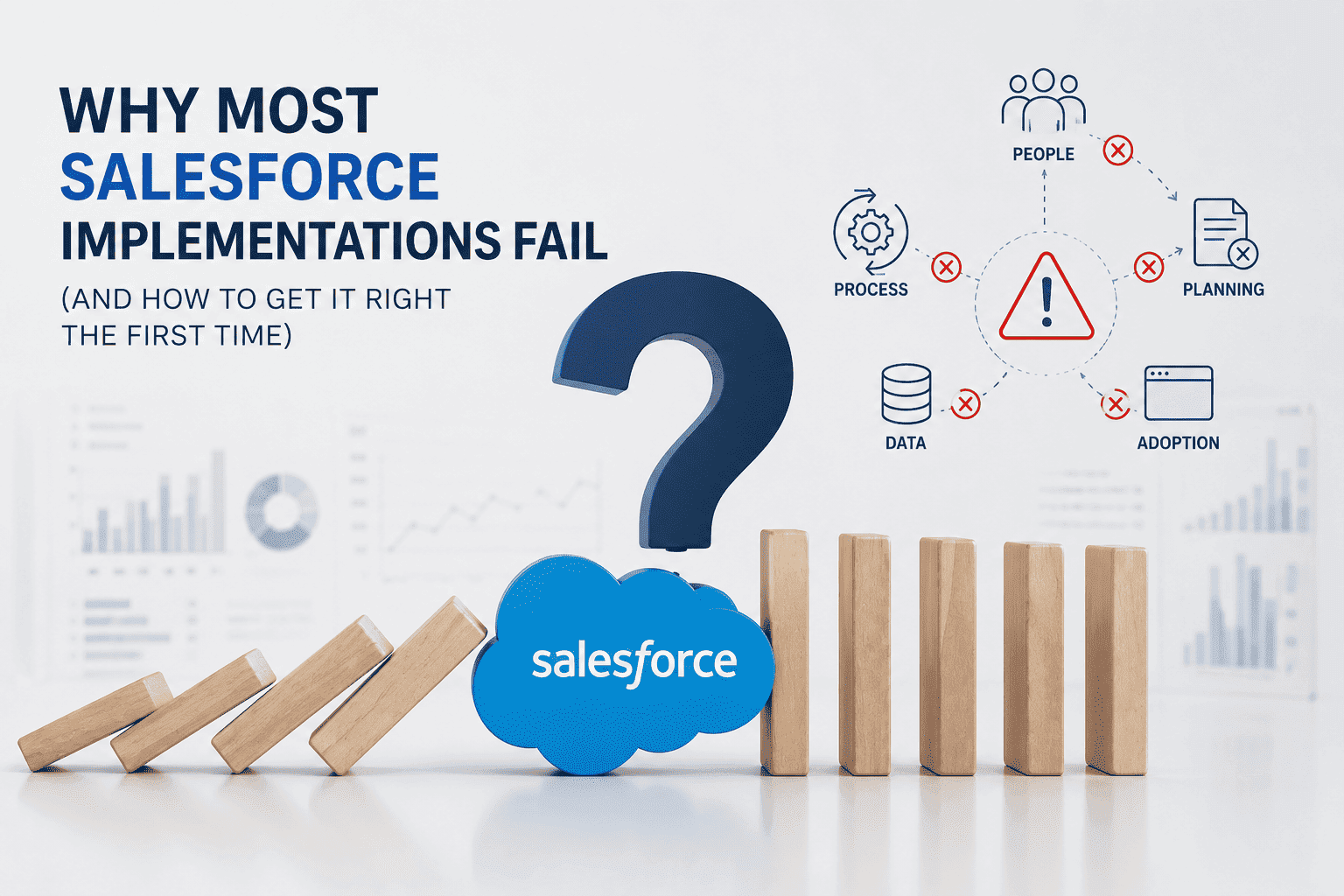
Treating Salesforce as a Technology Project
The biggest and most frequent mistake is viewing Salesforce implementation only as an IT task instead of a wider business transformation effort. Sales force affects sales processes, data, reporting, team behavior, and customer management. For it to succeed, the project must be guided by business goals, not just technical setup.
When the implementation is owned by IT, the success criteria tend to be technical: the system is live, the data is migrated, the integrations are working, and training has been conducted.
The real success criteria are behavioral: are reps using the system? Is pipeline data accurate? Is forecast reliability improving?
Salesforce changes how people work. Changing the way people work needs strong leadership support, clear communication about the purpose of the change, input from the teams who will use the solution, and continued guidance after launch. These responsibilities go beyond IT because they are about adoption, behavior, alignment, and long-term business success.
Skipping the Process Work
Salesforce is a platform that automates and structures your sales process. If your sales process is undefined, inconsistent, or undocumented before implementation begins, Salesforce will systematize the chaos rather than the clarity.
I have seen companies spend significant budget implementing Salesforce and then realize mid project that their sales team has no agreed definition of what a qualified opportunity looks like, or that different regional teams follow entirely different closing processes. Salesforce cannot resolve those organizational alignment gaps. It can only surface them, usually at the worst possible moment.
Before implementation begins, document your ideal sales process with input from the people who actually run it. Define your pipeline stages in terms of buyer decisions, not internal milestones Align on the criteria that define a qualified lead, and then clearly set the handoff process between marketing and sales. This planning does not have to be perfect from the beginning. It only needs to be detailed and clear enough so the Sales force setup can be configured around real business rules. Underinvesting in Change Management
A Salesforce implementation is a request for behavioral change. You are asking sales representatives who have developed their own systems and habits over years to abandon what works for them individually in favor of a shared system that benefits the organization.
That request will not succeed through training alone. It requires leadership visibly using and referencing Salesforce in their communication. It requires managers holding their teams accountable for data quality in pipeline reviews. It requires removing the workarounds (the spreadsheets, the personal task lists, the deal tracking in email) that compete with Salesforce for the team's attention.
Companies that budget 15 to 20 percent of total implementation cost for change management consistently achieve higher adoption rates. Companies that skip change management or treat it as a one day training event consistently see adoption collapse within three to six months of go live.
Scope That Grows Without Discipline
Salesforce implementations almost universally expand in scope once the build begins. A stakeholder attends a demo and requests a new feature. A sales manager raises a requirement that was not captured in discovery.
Without disciplined scope governance, each of these additions delays the project, increases cost, and dilutes the team's focus on delivering the core value. Define your minimum viable product scope explicitly at the start of the project. Document what is in scope and what is deferred to a future phase.
How to Get It Right the First Time
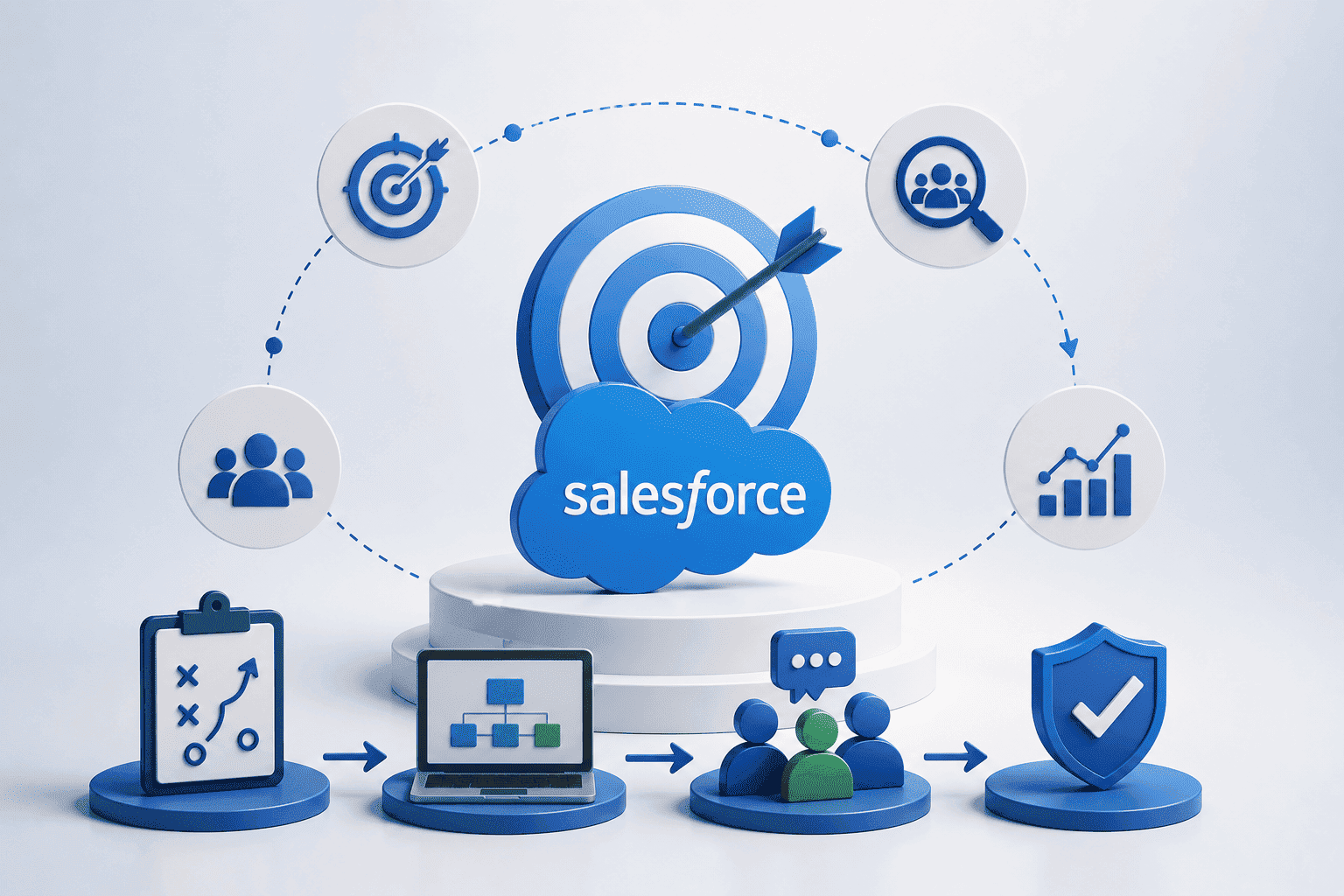
Define the specific business outcomes you are trying to achieve and work backward to the capabilities required to deliver them. Instead of "we want to implement Salesforce Sales Cloud," define "we want to improve our forecast accuracy from 65 percent to 85 percent within six months of go live." That outcome drives a very different set of configuration priorities.
Invest in Discovery
A robust discovery phase is the most consistently undervalued investment in a Salesforce project. Spend the time to thoroughly document your current state process, identify the gaps and friction points, and design a future state that genuinely reflects how your team sells. The implementation that follows will be faster, more focused, and more likely to achieve adoption.
Phase Your Delivery
Delivering a complex Salesforce implementation in a single large release is a high risk approach. Users cannot absorb significant behavioral change all at once, and a long implementation timeline means problems discovered late in the process are expensive to address.
Phase your delivery into waves. Wave one delivers the core pipeline management and reporting capabilities that represent immediate value. Wave two adds automation, advanced reporting, and integration complexity. Wave three addresses edge cases and optimization. Each wave delivers value and builds confidence.
Measure Adoption, Not Just Deployment
Define your adoption metrics before go live and measure them consistently. Adoption is not binary; it is a spectrum. Measure login frequency, record update rates, pipeline data completeness, and report usage. Build a 90 day adoption review into your project plan and treat declining adoption metrics as an urgent signal rather than a post project problem.
They are the ones that treat the implementation as a people project enabled by technology rather than a technology project that people happen to use.
Building for What Comes Next
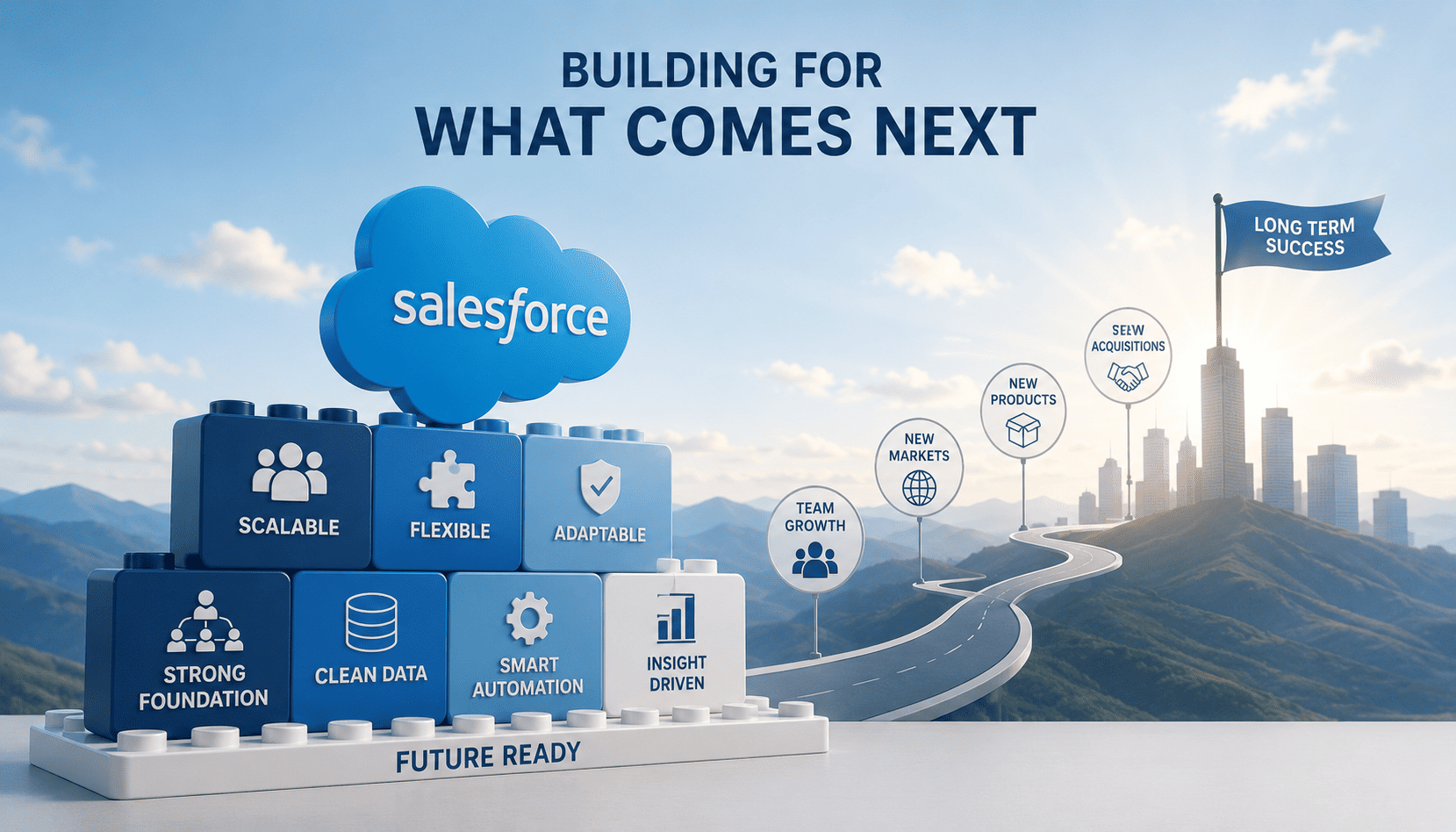
One of the most common and most costly mistakes in Salesforce implementations is building exclusively for the present state of the business. A configuration that works perfectly for a 30 person sales team may become a bottleneck at 100 people. A data model designed for a single product line may break when a second product is introduced.
Design your Salesforce implementation with your three to five year business trajectory in mind. If you plan to expand into new markets, ensure your territory management and account segmentation model can accommodate that expansion without a rebuild. If you plan to launch additional product lines, ensure your Opportunity object and product catalog architecture can support multiple lines without creating reporting confusion. If you plan to acquire companies, ensure your data model has a clear approach for integrating acquired customer records.
This foresight does not require building everything upfront. It requires designing a foundation that is extensible rather than rigid, and making deliberate choices about where flexibility matters most. The cost of building extensibility into the foundation is a fraction of the cost of rearchitecting a mature org when the business outgrows it. The organizations that get Salesforce right the first time are also the ones that continue to get it right as their business evolves, because they built with the future in mind from the beginning.

Get In Touch


Let's Talk Business
