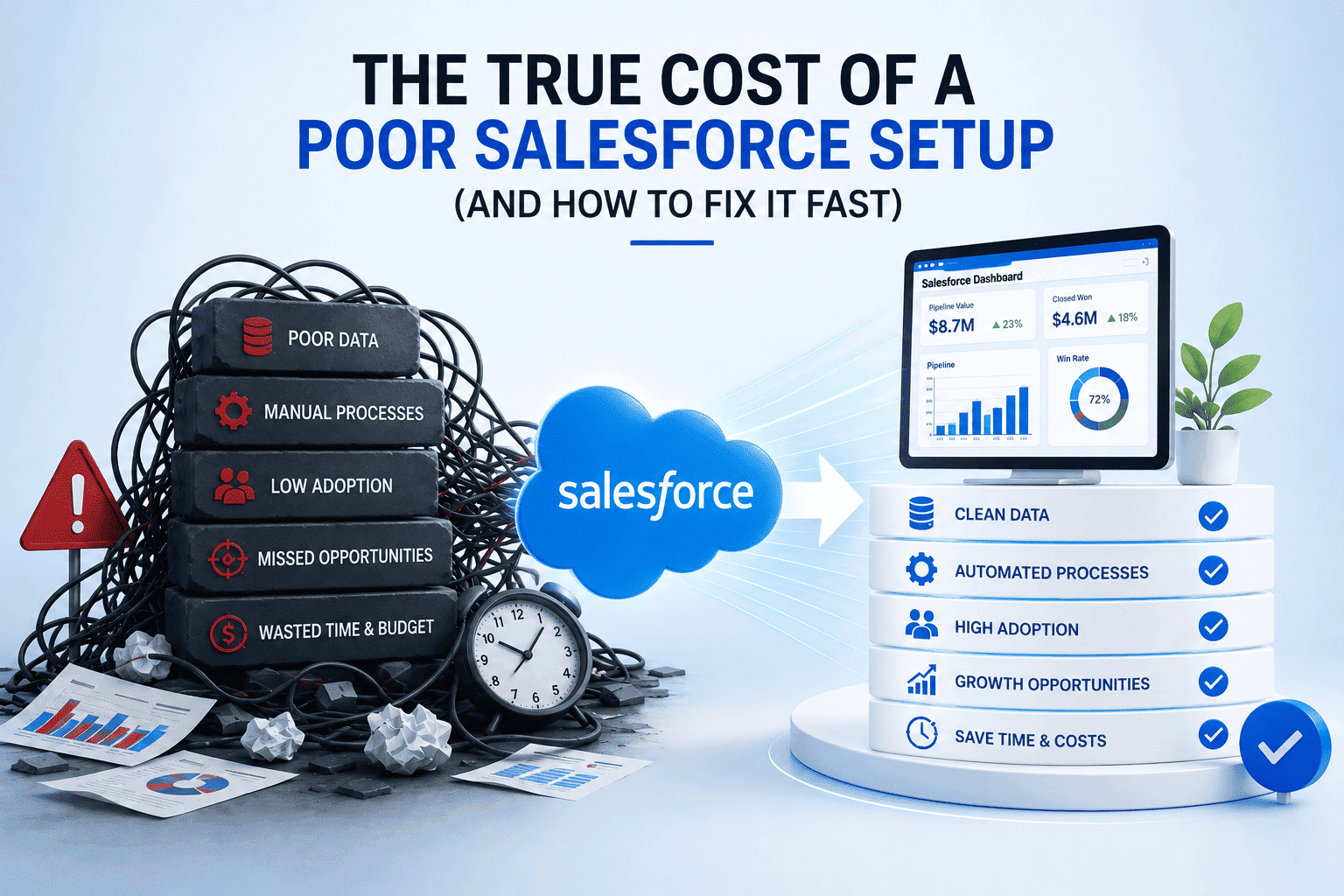
Most companies know their Salesforce implementation is not working the way it should. What they rarely know is exactly how much it is costing them.
They show up as friction, delay, frustration, and missed opportunity. They accumulate quietly until the day a sales leader pulls a pipeline report that no one trusts, or a CFO asks why the company is paying $180,000 per year for a platform that the sales team refuses to use.
I have walked into dozens of Salesforce orgs that fell into this category. What I have found is almost always the same: the cost is far higher than anyone imagined, and the path to fixing it is more achievable than anyone expected.
What a Poor Setup Actually Costs
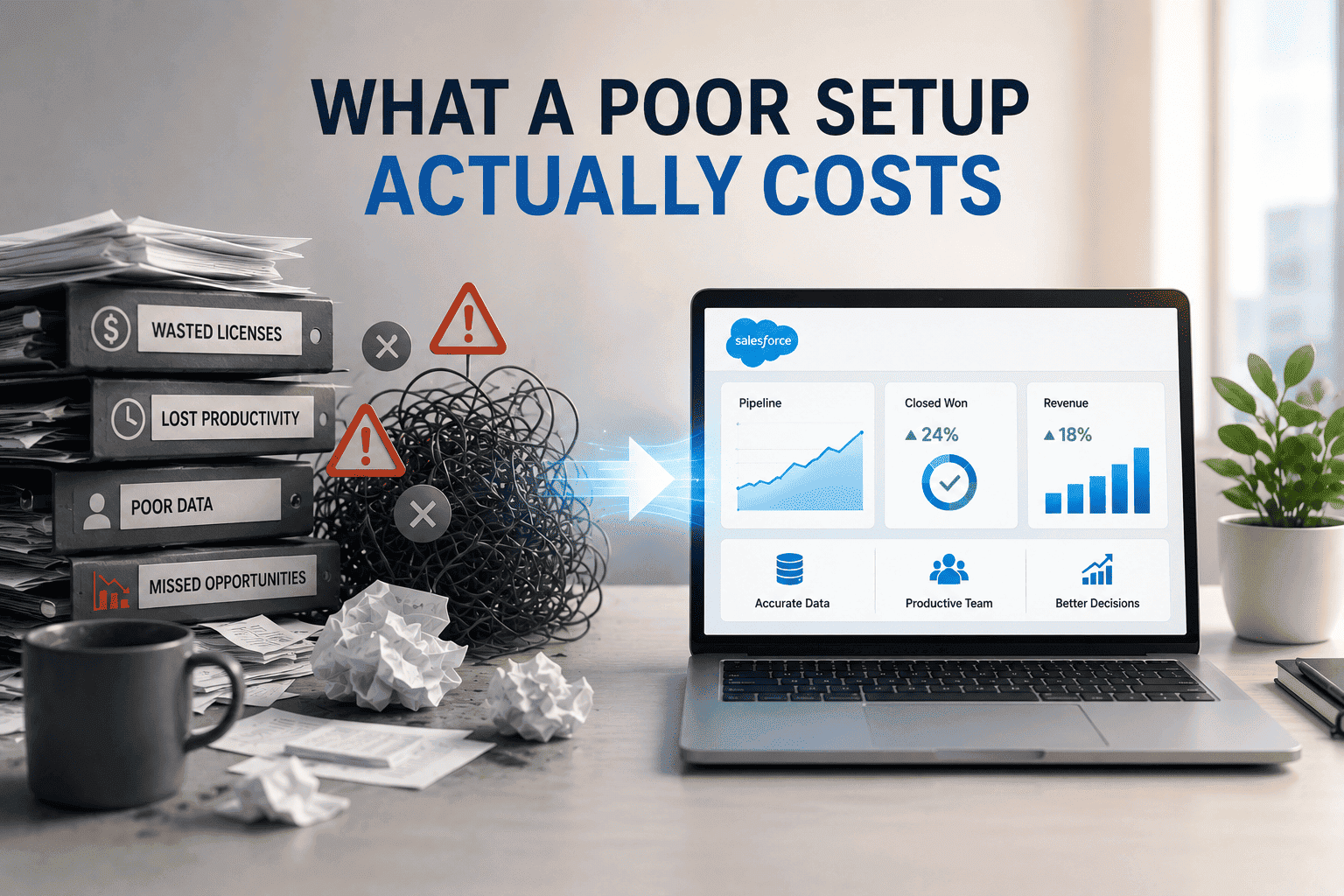
The most immediate and measurable cost is wasted license spend. Salesforce licenses are not cheap Enterprise Edition pricing begins at around $165 foreach user every month, while Unlimited Edition can cost more than $300 per user per month. These costs can increase depending on the number of users, selected features, required support level, integrations, customizations, and the overall Sales force setup needed by the business.
When your team is logging into Salesforce out of obligation rather than necessity, and conducting actual business in spreadsheets and email, you are paying premium prices for shelfware.
Beyond licensing, there is the cost of lost productivity. When Salesforce does not reflect how your team actually sells, reps work around it rather than within it. They enter data after the fact, they duplicate effort, and they spend time every week reconciling Salesforce records with their own personal tracking systems When a CRM is not configured properly, this problem can become even worse, creating more manual work, slowing teams down, and reducing overall sales productivity.
Then there is the cost of poor data. A Salesforce org that lacks proper validation rules, duplicate management, and field governance accumulates bad data at a predictable rate. Research by Experian Data Quality estimates that poor data quality costs organizations an average of 15 to 25 percent of revenue. When your pipeline is built on records that are incomplete, outdated, or duplicated, your forecasting is unreliable, your territory management is compromised, and your marketing automation is targeting the wrong people.
Finally, there is the opportunity cost of delayed decision making. When leadership cannot trust the data in Salesforce, they revert to gut instinct and anecdotal evidence to make strategic decisions. They miss early warning signs in the pipeline. They misallocate sales headcount. They invest in markets where they appear to have traction but actually do not.
Add it together. For a company with 50 Salesforce users, a poor setup can represent $1.5 million or more in annual cost when you account for wasted licenses, lost productivity, poor data decisions, and missed pipeline opportunities.
The Most Common Failure Patterns
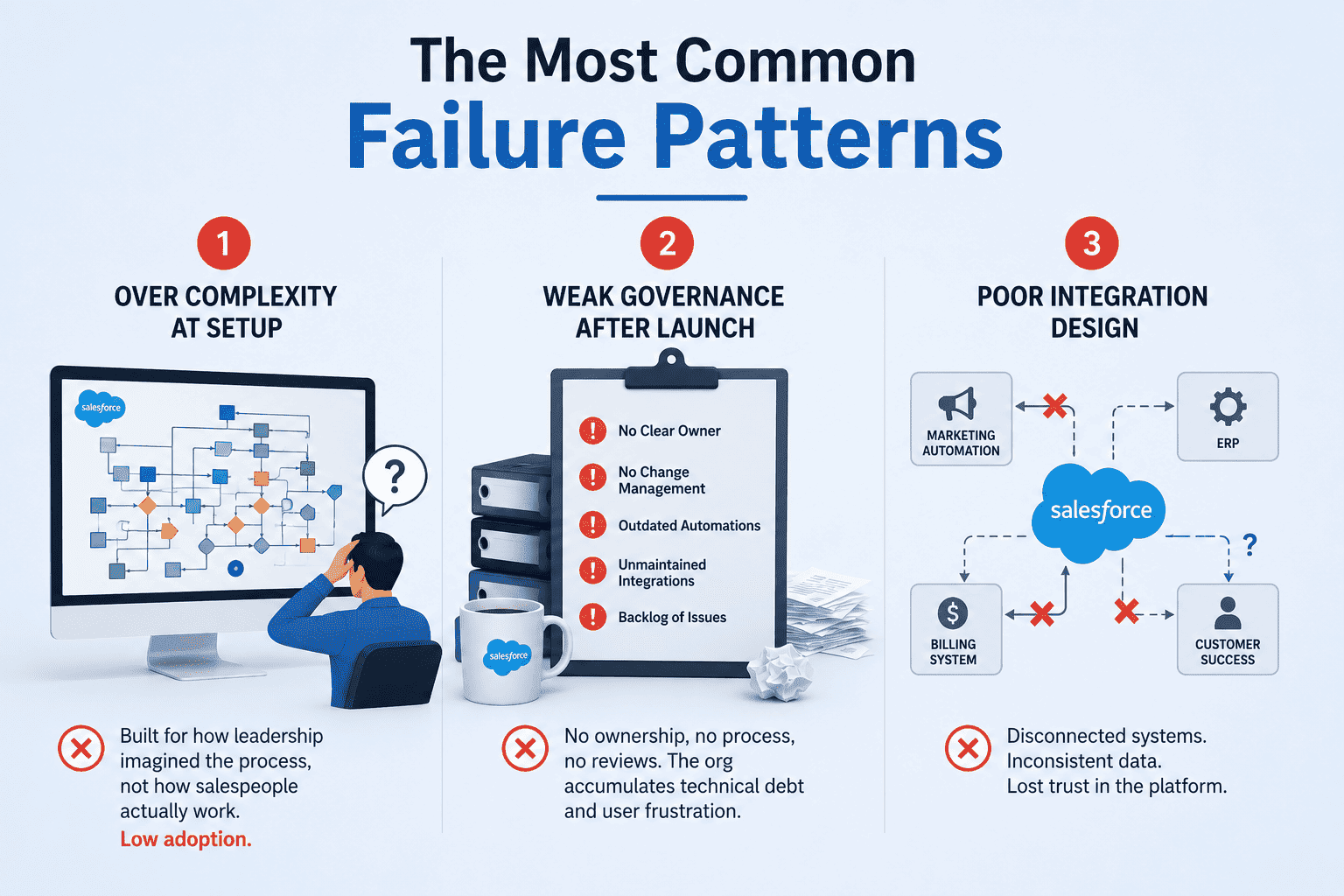
In my experience, poor Salesforce setups share a recognizable set of failure patterns.
The first is over complexity at setup. Well meaning administrators build fields, objects, page layouts, and workflows that mirror the way leadership imagined the process on a whiteboard, rather than the way salespeople actually work. The outcome is a system that feels more like unnecessary bureaucracy than a helpful business tool, causing user adoption to decline. The second issue is weak governance after launch. Sales force is not a platform that can simply be implemented once and then left unmanaged.
0Sales force is not a set and forget platform. Without a clear owner, a defined change management process, and regular architecture reviews, the org accumulates technical debt: redundant workflows, conflicting automation, unmaintained integrations, and a growing backlog of user complaints that no one has accountability to resolve.
The third is poor integration design. Most companies use Salesforce alongside a stack of other tools: a marketing automation platform, an ERP, a billing system, a customer success platform. When these integrations are built without a coherent data model or master data management strategy, data flows inconsistently, records diverge, and the platform loses credibility.
How to Fix It Fast
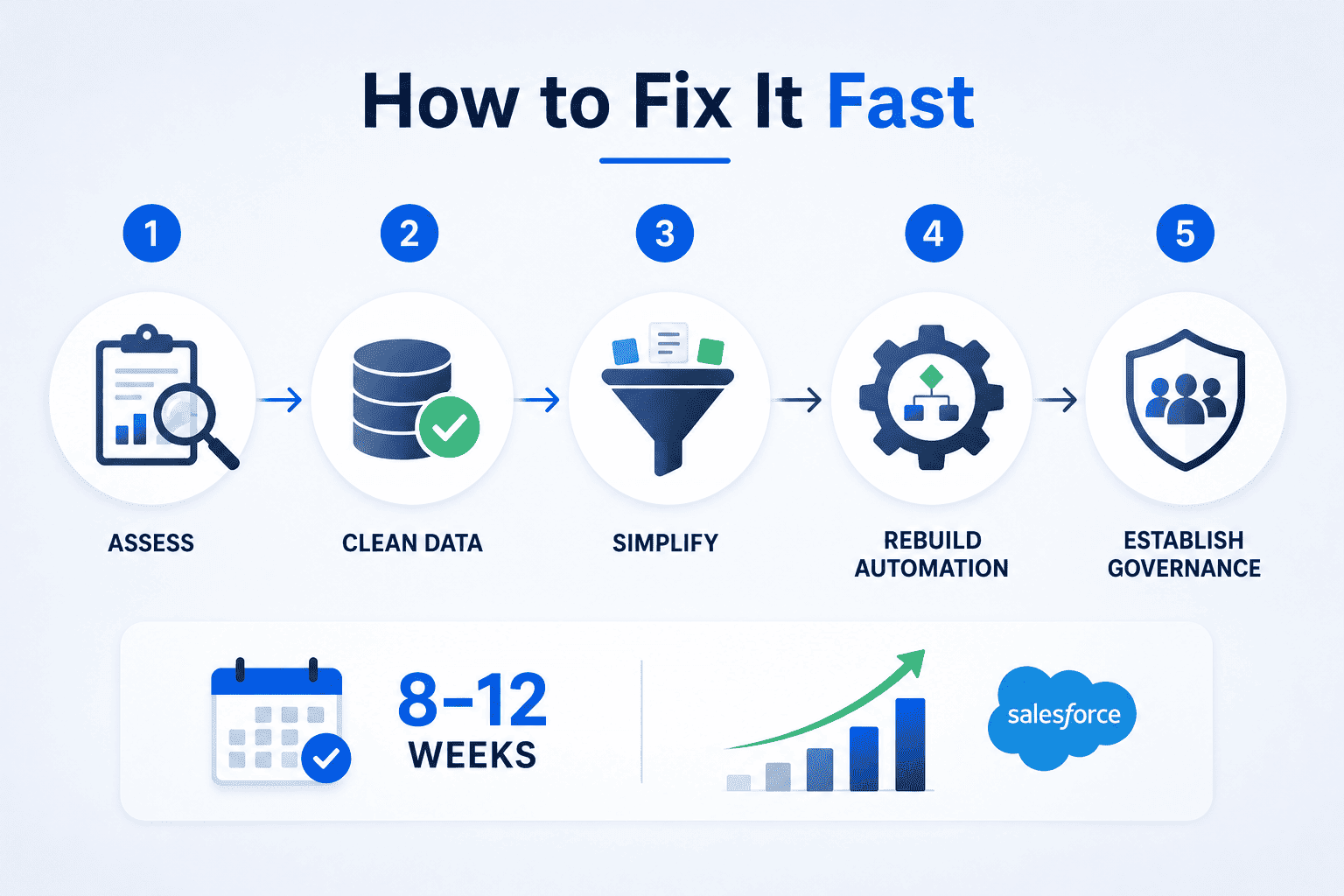
The fastest path to a functioning Salesforce org is a structured assessment before any configuration changes. Bring in someone who can audit your current state objectively: your data model, your automation architecture, your user adoption metrics, and your technical debt inventory.
From there, the fix follows a logical sequence. Start with data. A clean data foundation is not glamorous, but no other improvement will stick if the underlying records are unreliable. Implement deduplication, standardize picklist values, enforce required fields, and establish data ownership.
Next, simplify. Remove fields that are never populated. Consolidate redundant page layouts. Streamline your sales process in Salesforce to match what your reps actually do. Every unnecessary click is a friction point, and every friction point reduces adoption.
Then rebuild your automation with intention. Audit every workflow rule, Process Builder flow, and trigger. Consolidate redundant logic. Move to Flow where appropriate. Ensure your automation supports your process rather than complicating it.
Finally, establish governance. Assign a Salesforce owner with authority and accountability. Implement a change request process. Schedule quarterly architecture reviews. Define standards for naming conventions, field creation, and record types.
The turnaround from a broken Salesforce org to a functional one typically takes eight to twelve weeks when executed with focus and proper expertise. The ROI on that investment is immediate and measurable.
Preventing Recurrence
Remediation without prevention is a temporary fix. The same conditions that produced a poorly configured Salesforce org will reproduce the same problems unless you address the structural causes.
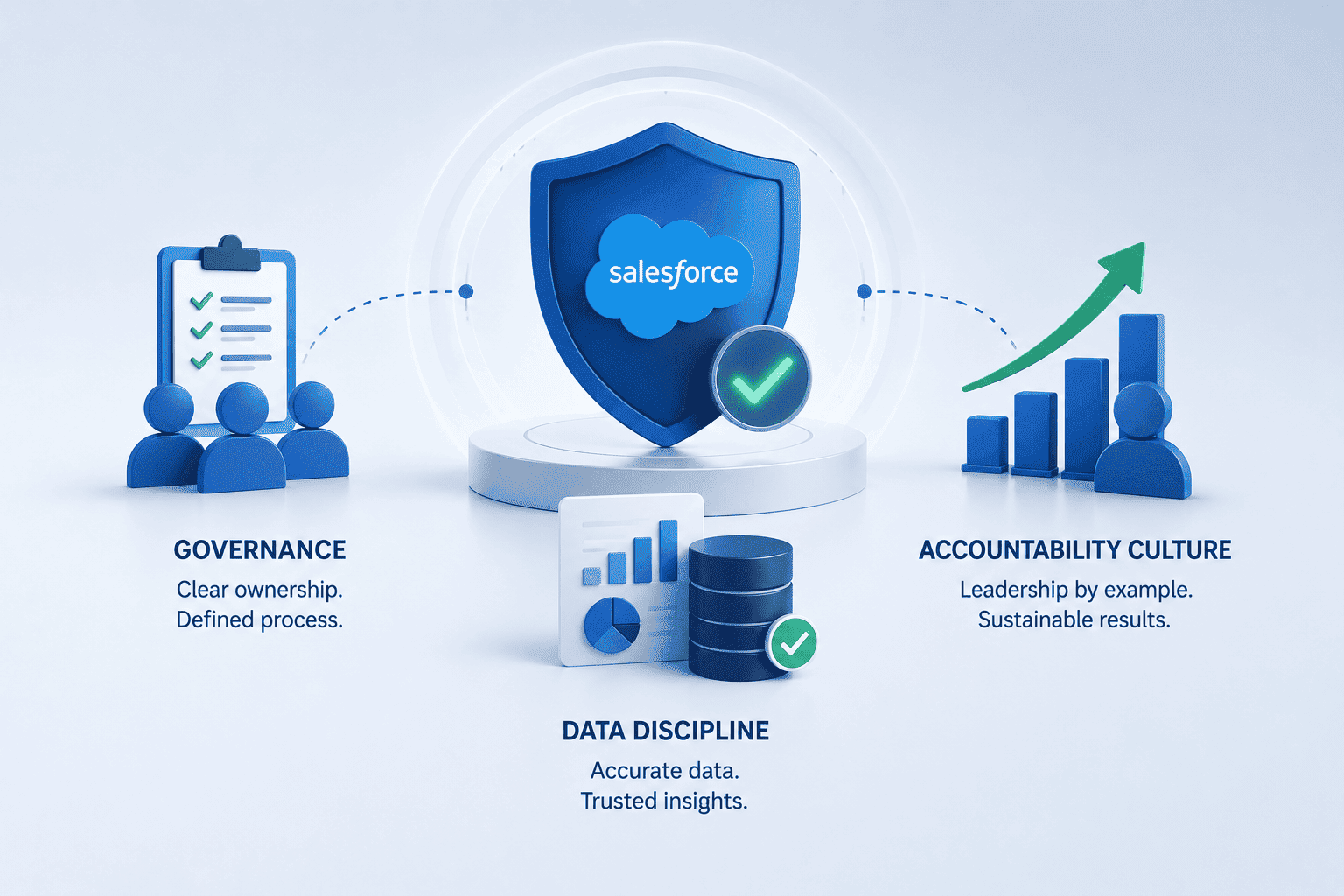
The most important structural change is governance. Salesforce needs a clearly designated owner with both the authority and the accountability to manage the platform strategically. This person should own the change request process, the architecture review cadence, and the adoption metrics. Without a designated owner, the org drifts back toward complexity and neglect regardless of how clean the remediation was.
The second structural change isa culture of data discipline. Sales managers who review pipeline in Salesforce rather than spreadsheets, who ask reps to update Salesforce before forecast calls rather than after, and who recognize good data hygiene as a professional standard rather than an administrative burden create the conditions for Salesforce to maintain its quality over time.
The platform cannot enforce a culture of accountability on its own. But when leadership treats Salesforce as a strategic business tool rather than an IT system, the team follows. That cultural signal, more than any configuration change, is what separates companies that get lasting value from Salesforce and those that find themselves rebuilding every two to three years.

Get In Touch


Let's Talk Business
