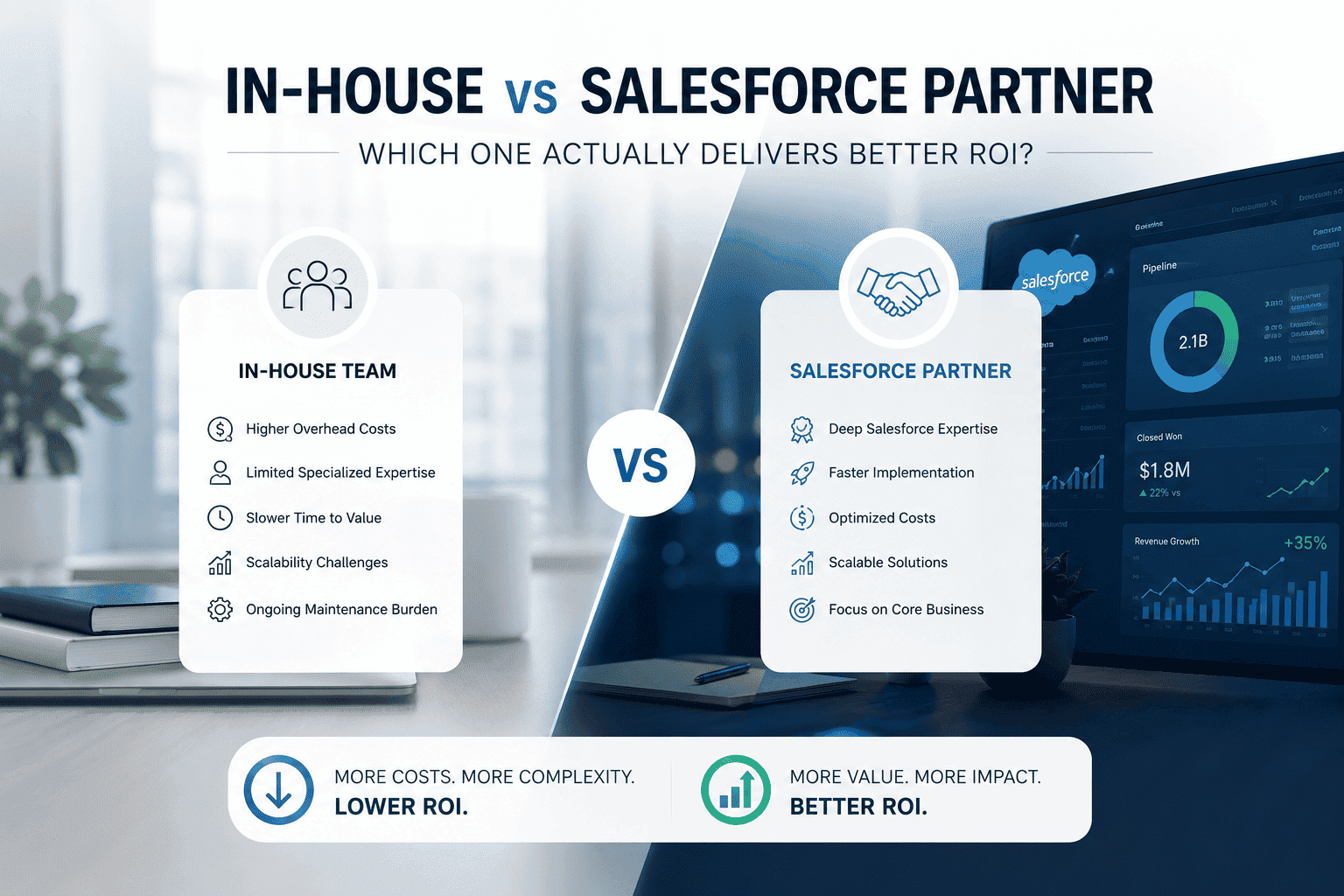
Every growing company reaches the same crossroads. Your Salesforce org is live, your team is using it (sort of), and someone in the boardroom asks the inevitable question: should we buildout an internal Salesforce team, or bring in a consulting partner?
It sounds like a straightforward resourcing decision. In practice, it is one of the most consequential investments your company will make, and getting it wrong costs far more than most executives realize.
Let me give you an honest, grounded answer rooted in what I have seen work and fail across dozens of Salesforce engagements.
The Case for Building In House
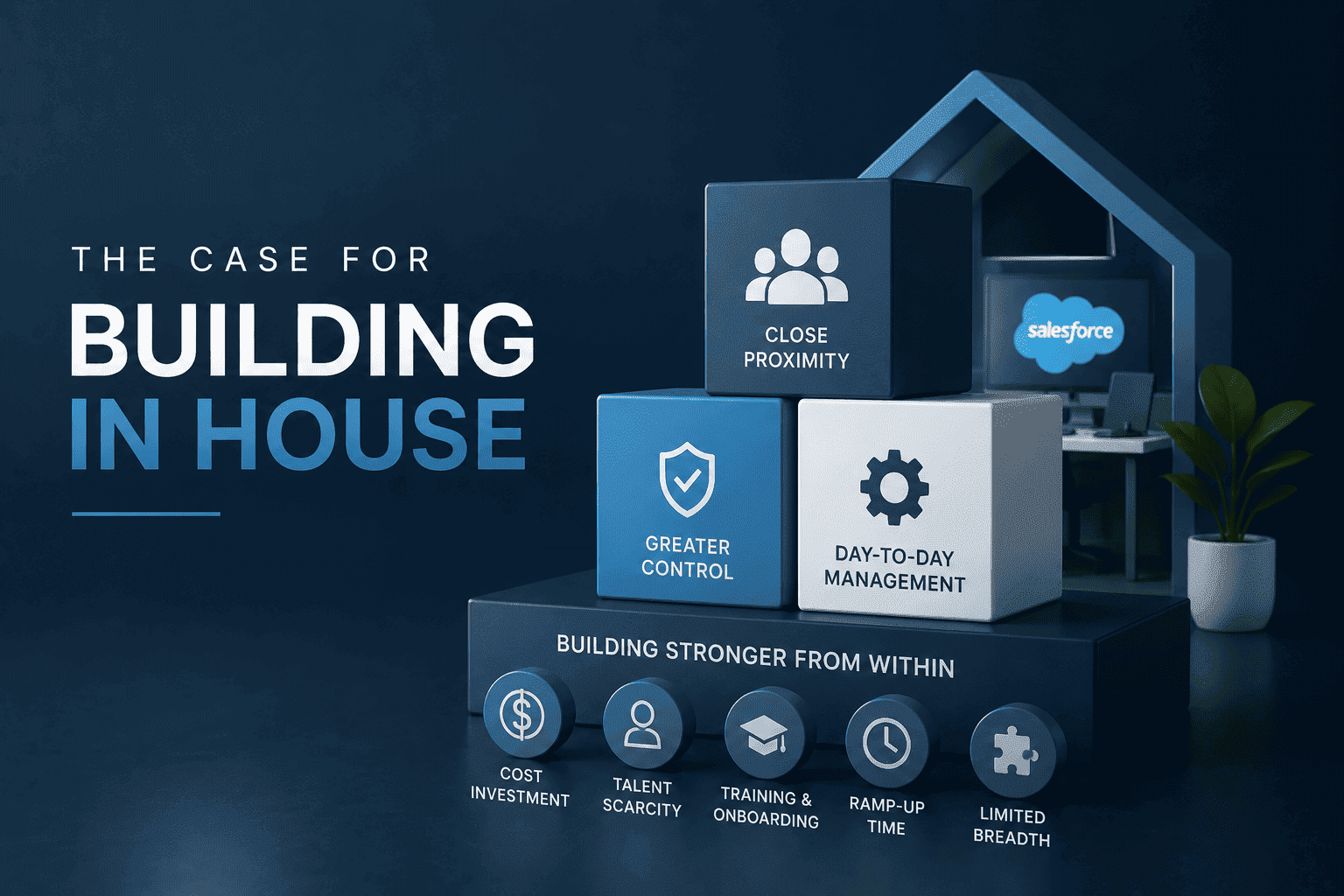
The appeal of an internal Salesforce team is understandable. Proximity matters. An in house administrator or developer is available every day, deeply embedded in your culture, and familiar with the nuances of your business. They attend your team meetings, they know your sales people by name, and they can respond to configuration requests without scheduling calls or writing project briefs.
There is also the perception of control. Many organizations feel more comfortable owning their Salesforce roadmap internally rather than depending on an outside firm to execute it.
And for certain scenarios, inhouse talent genuinely makes sense. If your Salesforce environment is relatively stable, your processes are well documented, and your needs are primarily administrative rather than strategic, a skilled in house administrator can manage the day to day operations effectively.
However, the cost picture is rarely as clean as it appears on a hiring budget. A mid level Sales in the United States currently commands a base salary between$85,000 and $110,000 A Sales force Developer skilled in Apex, Flows, and Lightning components can typically require an annual salary between $120,000and $160,000 or even higher. The final cost depends on experience level, technical expertise, location, project complexity, and the type of Sales force solutions the business needs to build or maintain. Add benefits, payroll taxes, onboarding time, training costs, and the productivity lag during ramp up, and your true annual cost for even a small internal team exceeds $300,000 before you have deployed a single feature.
More importantly, you are buying a narrow skill set. One person cannot be simultaneously expert in Sales Cloud, Service Cloud, Marketing Cloud, CPQ, integrations architecture, and change management. The breadth of Salesforce as a platform has expanded dramatically, and the idea that a single hire can cover your enterprise requirements is a persistent and costly myth.
What a Consulting Partner Actually Brings
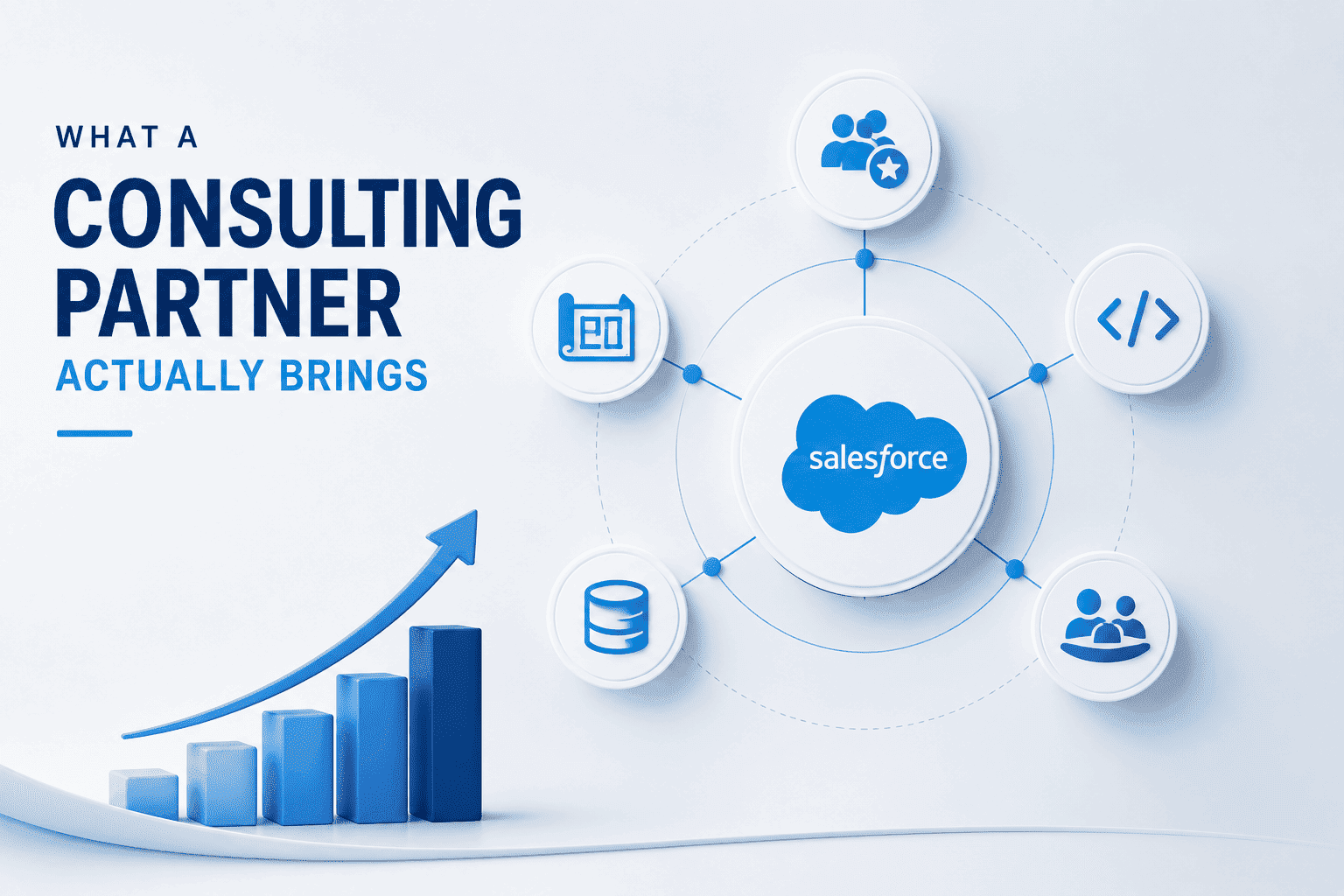
The value of a qualified Salesforce consulting partner is not simply about cost arbitrage. It is about access to a multi disciplinary team, proven delivery frameworks, and a depth of implementation experience that no individual hire can replicate.
When you engage a seasoned partner, you are not getting one person. You are getting a Principal Consultant who owns your strategic roadmap, a Solution Architect who designs the technical foundation, a Developer who builds the complex automation, a Data Specialist who ensures your records are clean and trustworthy, and a Change Management Lead who makes sure your team actually adopts what gets built. That team, working in coordination, compresses your time to value dramatically.
Partners also bring cross industry pattern recognition. If you are a B2B SaaS company look pipeline visibility, a good partner has solved that exact problem fifteen times before. They know which approaches work, which ones create technical debt, and which configurations you will wish you had built differently six months from now.
The ROI calculation changes significantly when you consider outcomes rather than inputs. Companies that engage qualified Salesforce partners consistently report faster deployment timelines, higher user adoption rates, and measurable improvements in pipeline velocity and forecast accuracy.
Where the ROI Numbers Actually Land
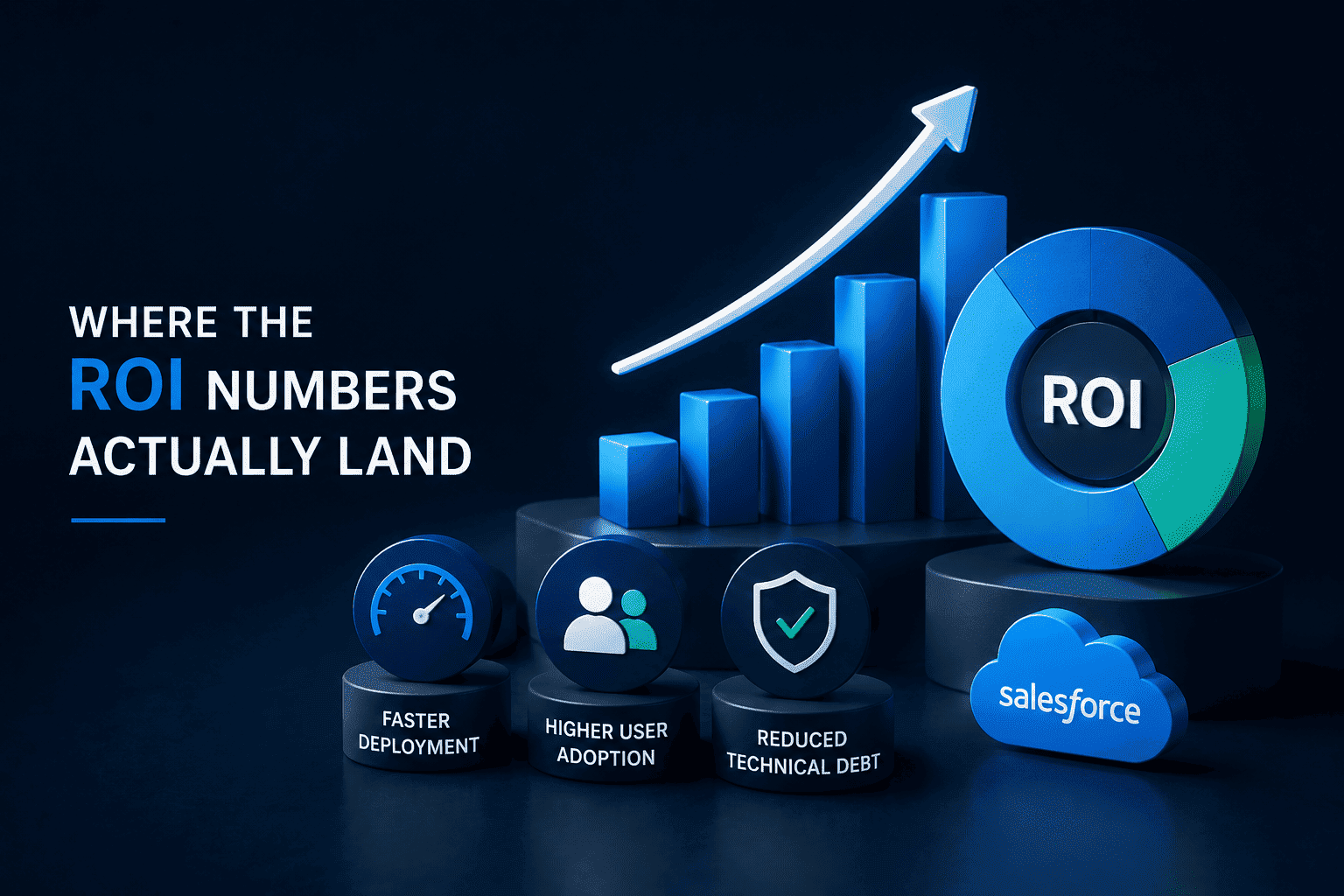
Let me be specific. Based on industry benchmarks and client engagements, companies that work with experienced Salesforce partners typically see:
Faster deployment means faster access to the productivity gains that justified the Salesforce investment in the first place.
A 30 to 50 percent improvement in user adoption within the first six months of go live, driven by a partner's structured training and change management processes. Low adoption is the silent killer of Salesforce ROI, and most in house teams are not equipped to address it systematically.
A measurable reduction in technical debt. Systems built by generalist administrators without architectural oversight accumulate fragility over time.
The in house model can be more cost effective over a three-to-five-year horizon if your org is stable and your needs are limited. But for companies in growth mode, undergoing process transformation, or attempting to unlock advanced Salesforce capabilities, the consulting partner model consistently delivers superior returns.
The Hidden Cost of Waiting
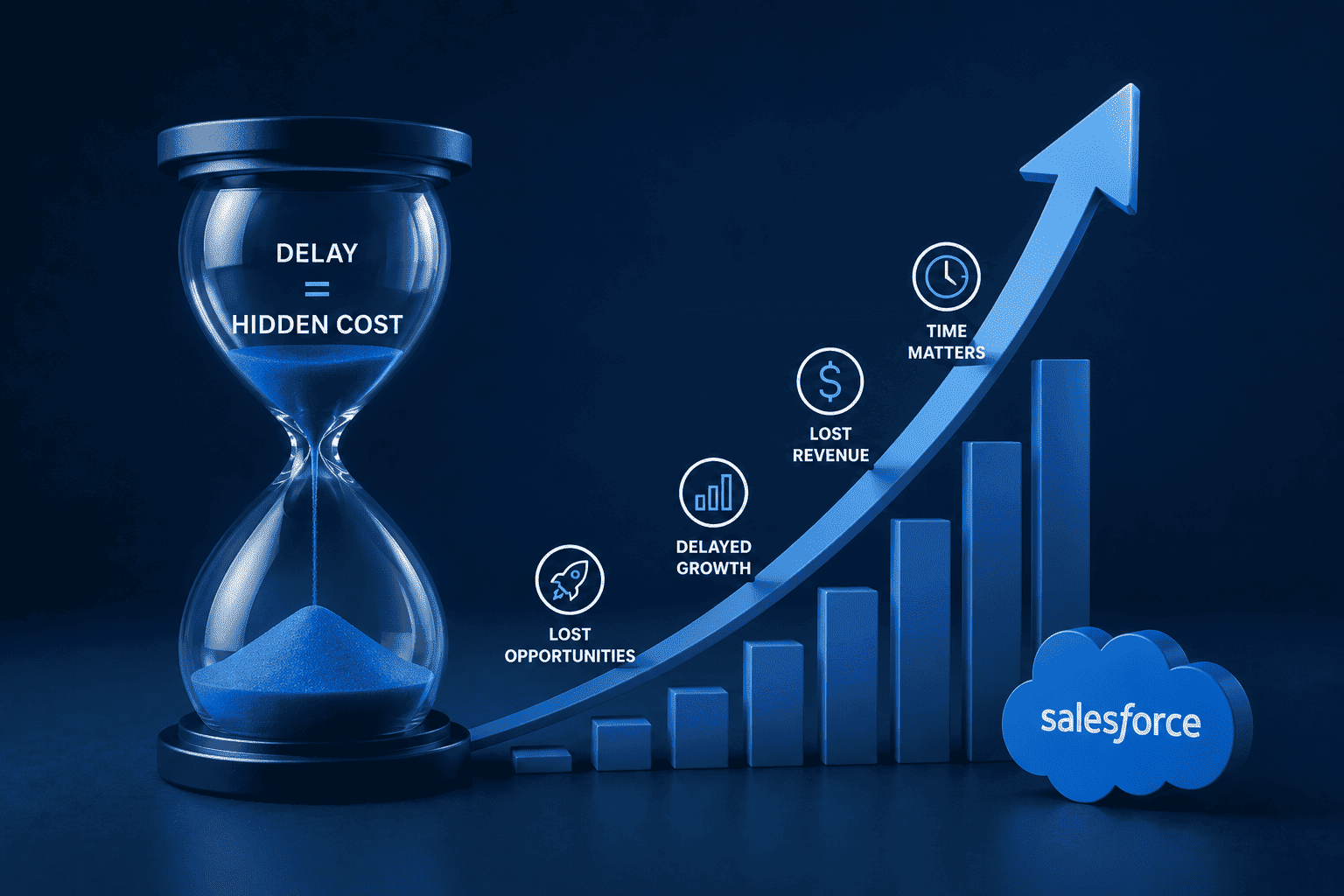
One dimension of the in house versus partner decision that rarely gets enough attention is timing. When a company decides to build an internal team, the hiring process alone typically takes three to five months. Add a three-to-six-month onboarding and ramp up period before the new hire is productive, and you are looking at six to eleven months before your internal team is operating at meaningful capacity.
A consulting partner can be mobilized within weeks, meaning your timeline to value is dramatically compressed.
For companies in active growth phases, this timing gap is not a minor consideration. It represents quarters of potential productivity improvement that remain unrealized because the decision to build internally added months to the delivery timeline.
When to Choose What

Choose an in house team when your Salesforce environment is mature and stable, your configuration needs are incremental and operational, you have the budget to hire across multiple specializations, and your business is not undergoing significant process change.
Choose a consulting partner when you are implementing Salesforce for the first time or conducting a significant rebuild, when you need to move quickly and cannot afford a six month hiring and onboarding process, when your requirements span multiple Salesforce clouds or require custom development, or when previous implementation efforts have stalled or failed to deliver adoption.
A hybrid model often represents the best of both approaches: a consulting partner to architect and build, paired with an in house administrator to manage and sustain. This combination gives you strategic expertise during the build phase and operational ownership during the run phase.
The Question That Actually Matters
The real question is not inhouse versus partner. It is this: what level of Salesforce capability does your business need to achieve its growth objectives, and what is the fastest, most reliable path to that capability?
Answer that question honestly, and the right structure becomes clear.

Get In Touch


Let's Talk Business
