
There is a phrase I use with clients when we first open their Salesforce org and start auditing their data: "You cannot build a revenue engine on a swamp."
It is not a polished consulting metaphor, but it is accurate. Data is the foundation on which everything in Salesforce runs: your forecasting, your segmentation, your pipeline management, your territory assignments, your marketing automation. When that foundation is unreliable, every insight you derive from it is compromised, and every decision you make based on it carries hidden risk.
Data problems are extraordinarily common. In nearly every org I have assessed, data quality has been a significant issue. The exact problems may look different from one business to another, but the underlying reasons the same. Most challenges come from repeated issues in process, strategy, setup, or execution. Because the causes are predictable, the right solutions can also be identified, applied, and improved with a clear approach.
Why Data Gets Messy
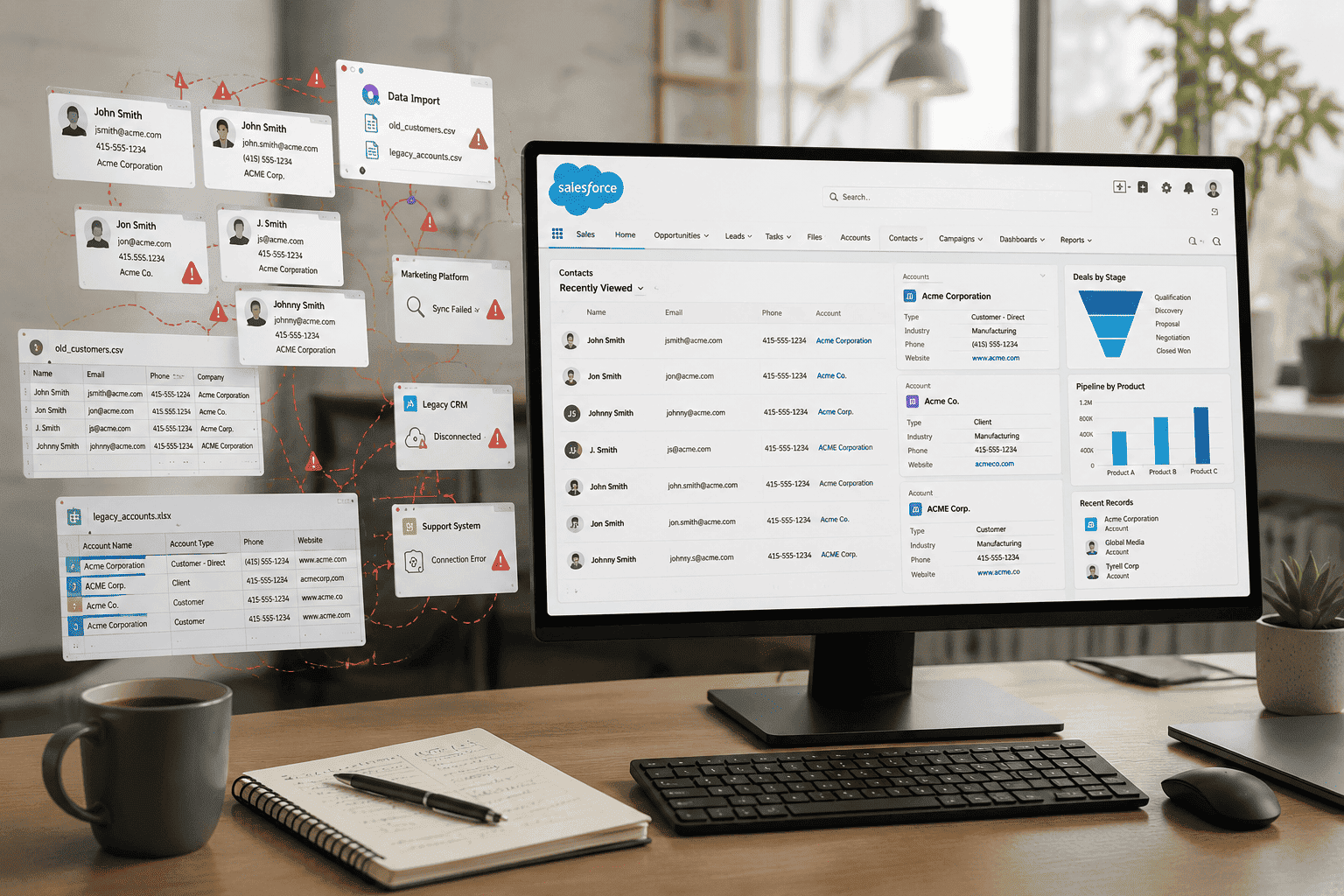
Salesforce data does not degradeovernight. It deteriorates through a predictable set of mechanisms.
The first is growth without governance. The team is small enough that inconsistencies are caught informally. As the organization scales, new reps are added, new territories are created, new products are launched, and the informal quality control that worked at twenty people fails entirely at two hundred.
The second is poor field design. When administrators create fields without clear definitions, naming standards, or picklist governance, different users interpret and populate those fields differently. One rep marks an opportunity as "Qualified" when the buyer has responded to an email. Another waits until a mutual action plan has been agreed. The field exists in the same place on the record, but it means different things to different people, and the data it generates is not comparable.
The third is migration residue. A significant percentage of data quality problems originate in historical data migrations. When a company moves from a legacy CRM or a spreadsheet based system into Salesforce, incomplete records, duplicated contacts, and inconsistent formatting get imported along with the legitimate data. Without aggressive cleaning before migration and validation after it, the new system inherits the failures of the old one.
The fourth is integration gaps. When data flows between Salesforce and external systems without a clear master data management strategy, records diverge. The account name in Salesforce differs from the account name in the ERP. The contact email in Salesforce conflicts with the email in the marketing automation platform. Over time, these divergences multiply and reconciliation becomes a project in itself.
The Cost of Dirty Data
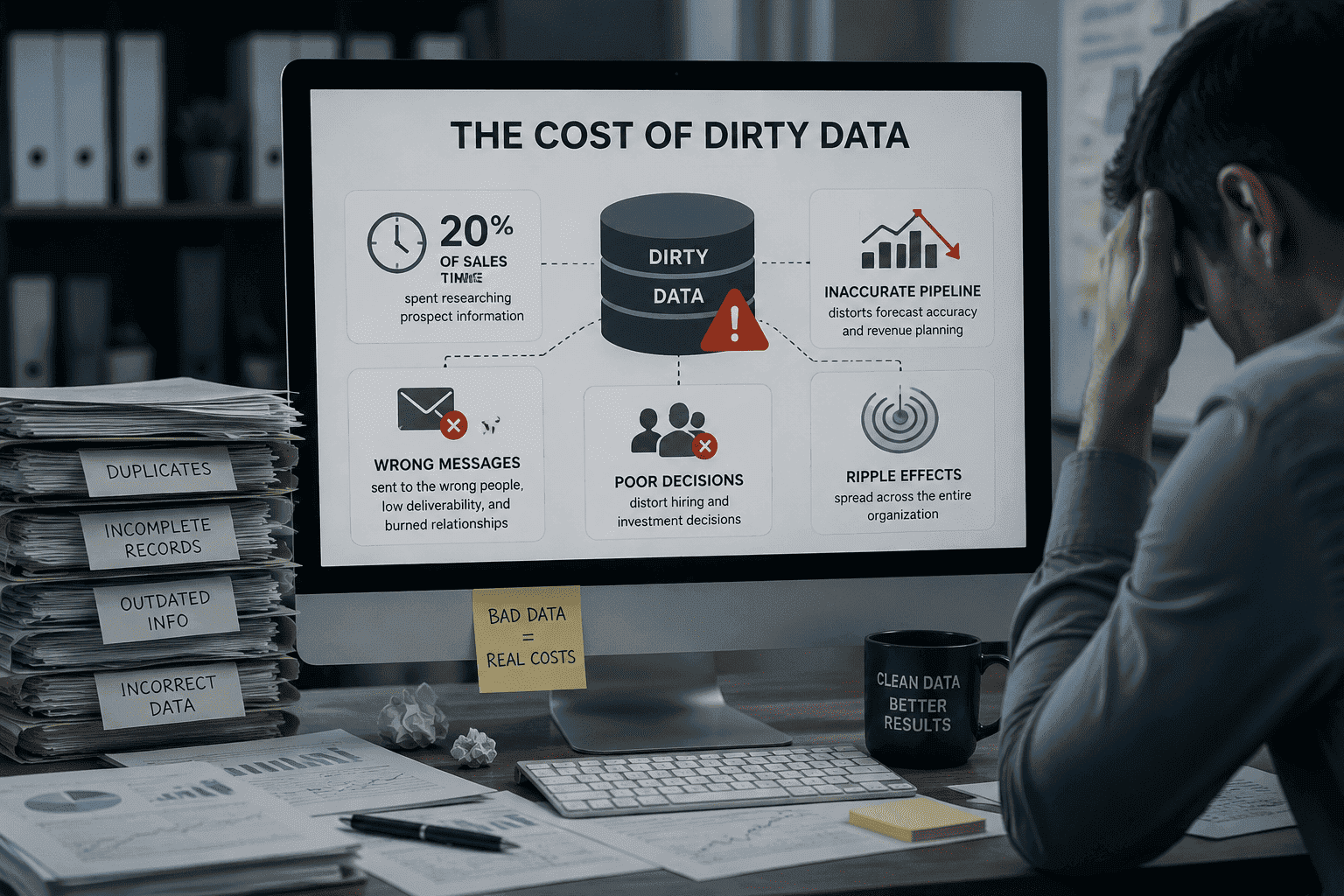
Before diving into the fix, itis worth anchoring on what poor data quality actually costs.
Forrester Research has found that sales representatives spend approximately 20 percent of their time researching prospect information that could be automatically populated with clean, well governed CRM data.
Inaccurate pipeline forecast accuracy, which distorts revenue planning, which distorts hiring and investment decisions. The ripple effects of a single data quality failure at the foundation of your CRM extend throughout the organization.
Marketing automation configured against dirty data sends the wrong messages to the wrong people, suppresses deliverability rates, and burns prospect relationships before a sales conversation can happen.
The Data Cleanup Framework
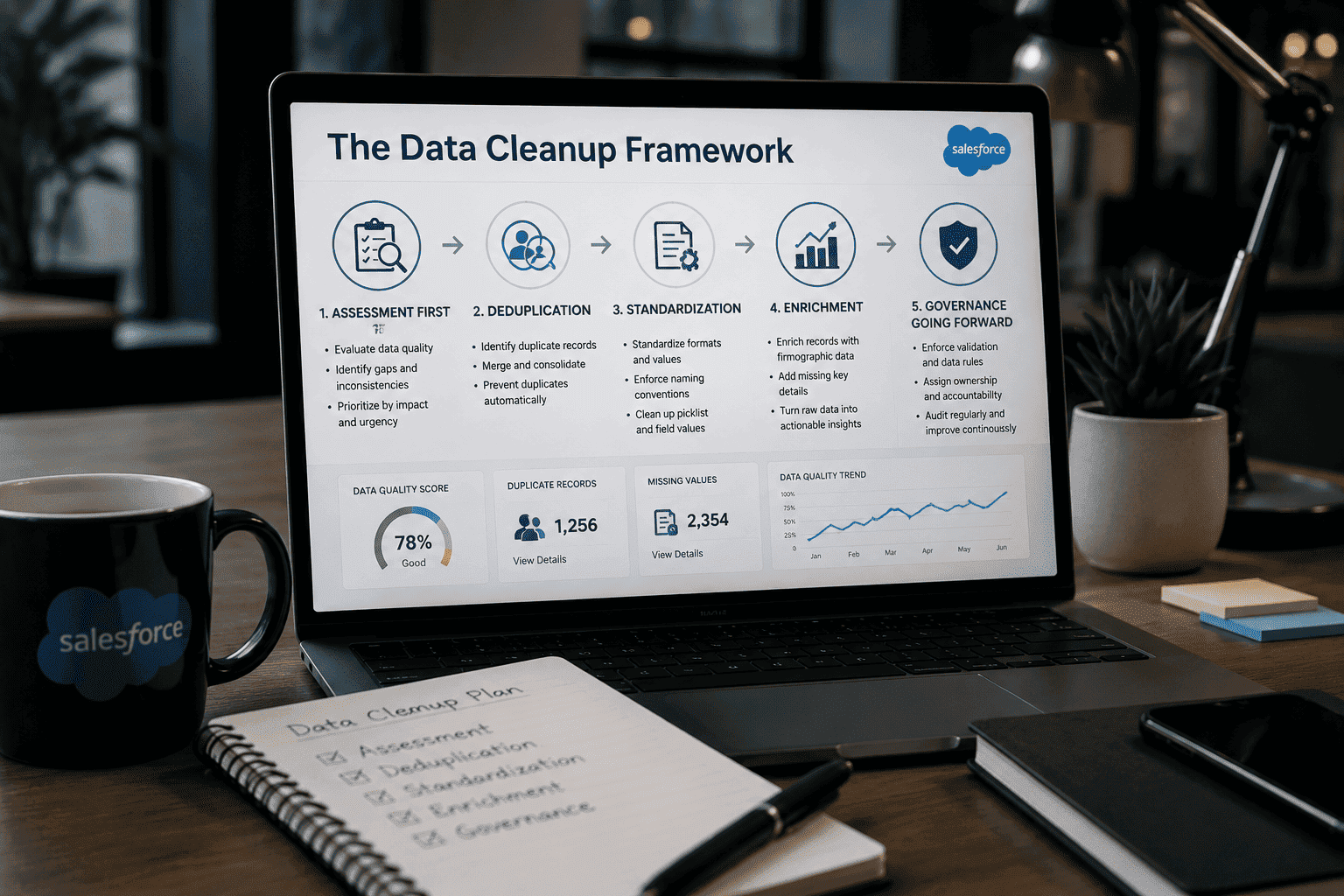
Cleaning Salesforce data is a project that requires structure, tooling, and governance. Here is the framework use with clients.
Assessment First
Before cleaning anything, assess the scope and nature of the problem. What percentage of Account records are missing key fields? What is the duplicate rate among Contacts? How many Leads have been sitting without activity for more than six months? What percentage of Opportunities have close dates in the past?
This assessment gives you a prioritized view of where the data quality problems are most severe and most consequential.
Deduplication
Duplicates are typically the most urgent problem because they corrupt virtually every downstream process. Use a deduplication tool such as Cloudingo or Demand Tools to identify and merge duplicate Leads, Contacts, and Accounts. Establish matching rules that define what constitutes a duplicate in your specific context, and automate duplicate prevention going forward.
Standardization
Standardize the format of key fields. Company names should follow a consistent capitalization and abbreviation convention. State and country details should also follow approved standard codes instead of open text entries. This helps keep records clean, reduces confusion, improves search accuracy, and makes reporting, integration, and data validation much easier for teams.
Pick list fields should have a defined, validated set of values with no legacy options that are no longer used.
Enrichment
Tools that integrate with Salesforce can automatically populate missing firmographic fields such as employee count, annual revenue, industry, and technology stack based on the company domain. This transforms skeletal records into actionable account profiles without requiring manual research.
Governance Going Forward
Data cleanup only provides short-term improvement when the original causes are ignored. If the same weak processes, unclear rules, manual errors, or poor system controls remain in place, the problem will return again.
Lasting data quality requires fixing the source of the issue, not only correcting existing records. Establish validation rules that enforce required fields at the point of data entry. Implement duplicate prevention rules that flag potential duplicates before a record is saved. Create data stewardship accountability, assigning specific team members responsibility for maintaining data quality in their records.
Conduct quarterly data quality audits to catch degradation early before it compounds.
What Clean Data Unlocks

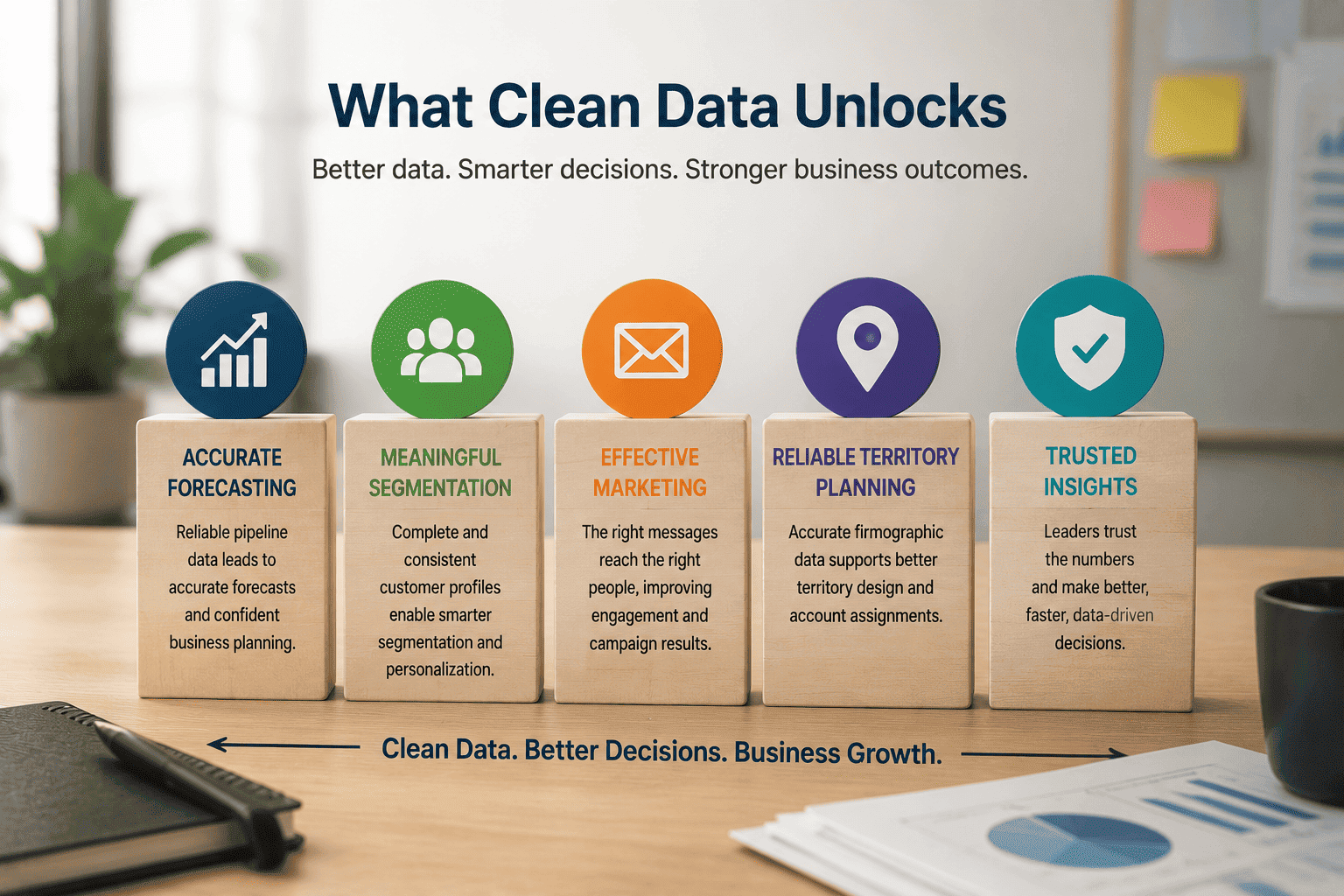
The payoff from a properly cleaned and governed Salesforce data set is not just operational tidiness. It unlocks capabilities that were previously impossible.
Forecast accuracy improves because pipeline data reflects reality. Segmentation becomes meaningful because account and contact profiles are complete and consistent. Marketing automation performs because the right messages reach the right people. Territory planning is reliable because account assignments are based on accurate firmographic data.
Most importantly, leadership begins to trust the numbers. When executives can rely on Salesforce as a source of truth rather than a best guess, the quality of strategic decisions across the organization improves measurably.
The organizations that treat it as such build the data foundation that makes every other Salesforce initiative possible.
The Ongoing Investment in Data Quality
One clarification worth making: data governance is not a maintenance cost.
Organizations that maintain clean, governed Salesforce data are able to execute faster and more accurately on every initiative they undertake. When a new product launches, they can segment their existing account base and identify ideal targets within hours rather than weeks
When leadership wants to assess market penetration in a new geography, the data to answer that question exists and is trustworthy. When a marketing campaign runs, the contact records it targets are accurate, and the engagement signals it generates flow cleanly back into Salesforce.
Every initiative you run on a clean data foundation performs better than the same initiative run on dirty data. Overtime, that performance premium accumulates into a substantial competitive advantage.
Set your data quality standards high, govern them rigorously, and measure them consistently. The organizations that do this find that their Salesforce investment continues to deliver increasing returns long after the initial implementation investment has been fully recovered.

Get In Touch


Let's Talk Business
