Part 1: The Case Merchants Keep Getting Wrong
Reading Time (min) : 12
Author Name : Umar Farooq
I’ve sat across the table from merchants who open the conversation the same way. They’ve seen a competitor’s buttery smooth storefront, read a post, watched a YouTube video, and they lean in and say it’s like a decision that’s already been made: “We want to go headless.” I’ve been guilty of endorsing it too. But time has taught me otherwise—and here’s why.
I’ve come to treat that sentence the way a doctor treats a patient who walks in and announces their own prescription. It’s not that they’re wrong to want to cutting edge. It’s that they’ve skipped the diagnosis and jumped to the treatment. And headless, done as a reflex instead of a decision, is expensive surgery.
This is the disconnect I want to fix in this guide. Somewhere along the way, headless stopped being an technological choice based in business reality and became a feather in the brands cap a thing ambitious brands have. But aspiration is not a reason, and a trend is not a strategy. In my years working Shopify apps and e-commerce storefronts at Alchemative, I’ve learned hard truths that I’ll put plainly.
Headless is either a deliberate trade you make to solve a named problem, or it’s an expensive monument to a trend you didn’t need to follow. There is no in-between.
This is not a theoretical exercise. This is a practical guide for the CEOs and e-commerce heads who are tired of being sold the medicine before the diagnosis. I’ll cut through the jargon, kill the one myth that derails most of these conversations and replace “we want to go headless” with something far more useful: a clear test for whether you’ve actually earned the right to spend the money. I’ll draw on my own experience and also what Shopify itself delivered over the last two years, because the platform changed underneath while we were debating this.
Lets for a moment stop treating headless as a status symbol and start treating it as the business decision.
Section 1: What Headless Actually Is and the Myth
Let me give you the plain language version first, because the term has been so overloaded it’s nearly lost meaning. Here’s how I define it:
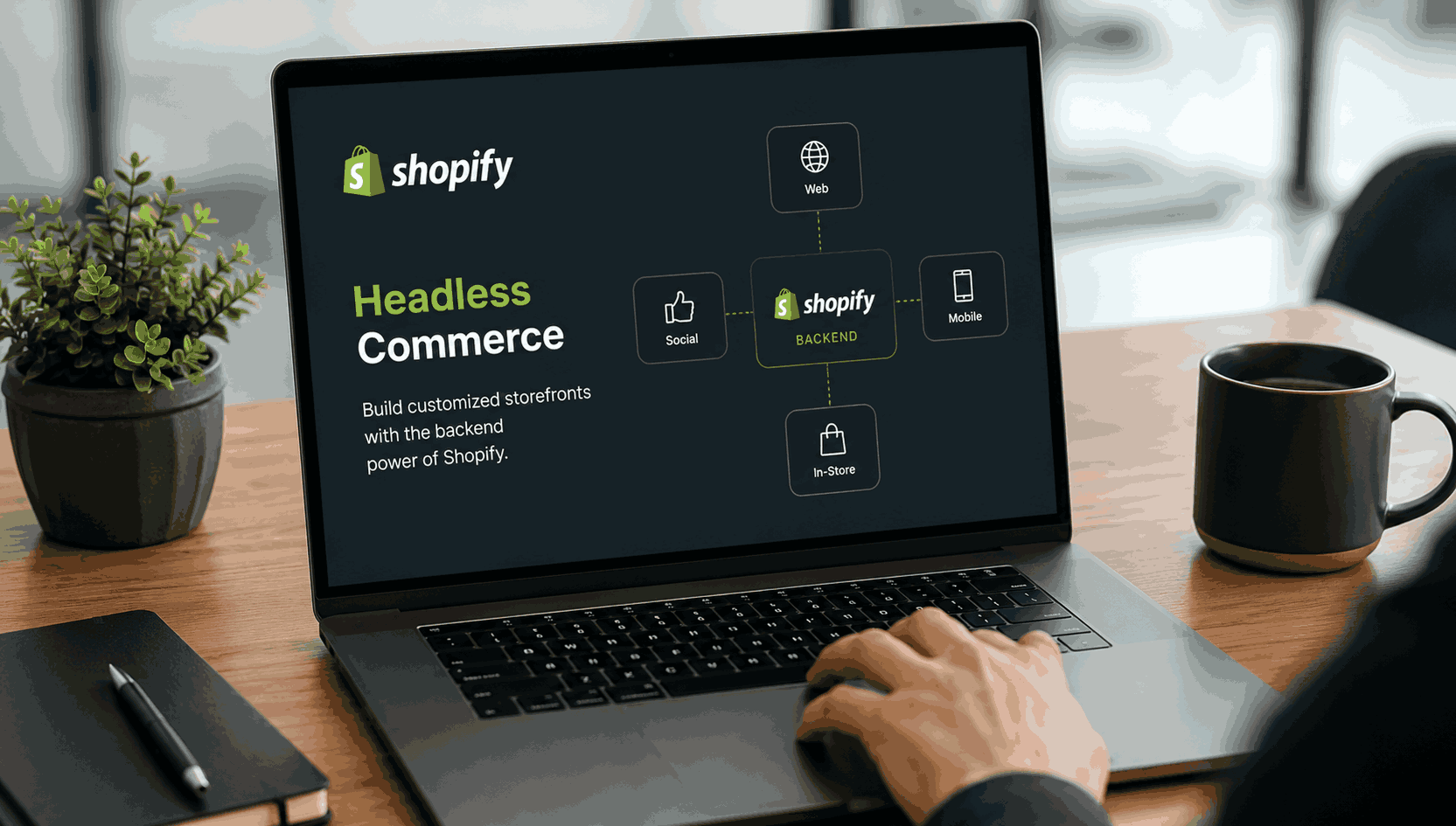
Headless commerce is the decoupling of the storefront what your shopper sees and touches from the commerce engine that runs the business underneath it. The face is yours to build; the engine stays Shopify’s.
A normal Shopify store is coupled. The storefront (a theme, built in Shopify’s Liquid language) and the core (catalog, cart, checkout, orders) live together on Shopify. Headless separates them apart. Your storefront becomes its own application built in React or Vue or whatever and it pulls product and cart data from Shopify through an API (the Storefront API). Shopify still runs the commerce engine. You’re just building your own face for it.
That’s the whole idea. Everything else is detail. And now the myth that derails the first conversation more than any other:
The Myth: “Going headless means we finally control checkout.”
You don’t. And — this is the part people resist, you shouldn’t want to.
On Shopify in 2026, checkout stays Shopify hosted. This is the architecture. The old Checkout API that once let apps build their own checkout was switched off on April 1, 2025. The modern pattern is straightforward: you manage the cart through the Storefront Cart API, then redirect the shopper to Shopify’s hosted checkout through the checkout URL. You customize that checkout through Checkout Extensibility blocks, app extensions, Shopify Functions, not by rebuilding it.
When merchants hear this, they feel cheated. “So it’s not really 100% headless?” And thats where I ask them to drop the perfect definition, because it’s costing them. Shopify’s checkout is the single most optimized, most compliant, highest converting surface in your entire stack. It carries PCI compliance, fraud tooling, ShopPay’s one-tap acceleration and conversion patterns tuned across millions of stores. The day you “win” the right to rebuild it is the day you inherit a problem you are statistically guaranteed to do worse than Shopify does.
So I tell people to stop saying “headless” and start saying what it actually is:
Headless on Shopify is not full decoupling; it’s frontend freedom with the engine intact. You get JS App level control over everything up to the buy button and you keep the one surface you should never touch. If what you really wanted was a different checkout, different payments, a different everything then you didn’t want headless Shopify. You wanted a different platform.
Section 2: What Headless Genuinely Solves
Strip away the hype and headless solves four real problems. If you can’t point to at least one of them and feel it in your business, you don’t have a reason yet.
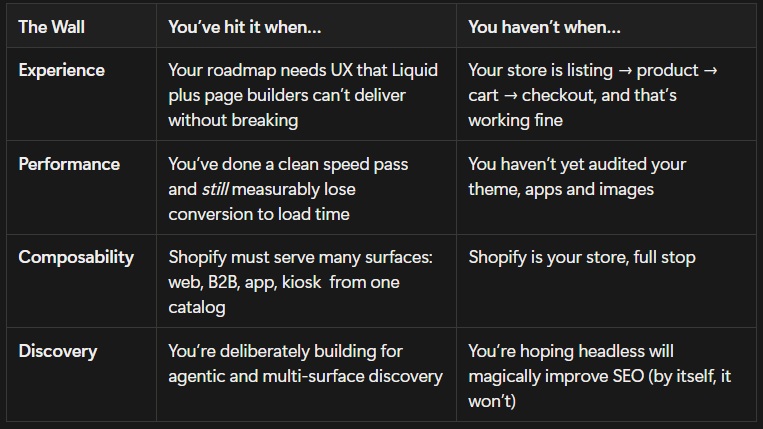
1. Experience: Your theme physically cannot express. Liquid is a templating language, not an application framework. It is excellent inside the patterns it was built for product pages, collections, cart. But the moment your brand needs something outside those patterns a real configurator, a quiz-driven storefront, a genuinely app like interface, Liquid starts to fight you. You end up stacking page builder apps on top of each other until you have a storefront nobody on the team wants to touch. Headless hands you a real frontend framework, so the experience is limited by your imagination and budget, not by the template engine.
2. Performance: But only after you’ve done the cheap fixes. Read this one twice, because it’s where most people quietly lie to themselves. Headless can make a store faster: a well-built Hydrogen storefront with server-side rendering and edge caching commonly buys you somewhere in the range of 0.4 to 1.2 seconds of LCP over a well-tuned Liquid theme. That’s real. It is not “ten times faster,” whatever the deck said. And it only counts if you’ve first done the boring work killed the app bloat, fixed the images, trimmed the scripts. Most stores that “need headless for speed” have a hygiene problem, not a platform problem. Spending six figures to fix a five thousand-dollar problem is the most expensive mistake in this entire field.
3. Composability: When Shopify is one system among many. Some businesses genuinely outgrow “a store.” They run a content-heavy brand site, a B2B portal, a mobile app, in-store kiosks all needing the same catalog and cart. They have a separate CMS, a PIM, an ERP. In that world, Shopify becomes a commerce service that many surfaces consume and a coupled Liquid theme is the bottleneck. Headless lets you treat Shopify as one composable piece of a larger system. This is the legitimate enterprise case but notice it’s a systems problem, not a storefront problem.
4. Discovery: The surface that just moved under everyone’s feet. This is the new one, and it’s why this conversation looks different in 2026 than it did in 2023. Shopify has wired its storefronts into agentic commerce: the Storefront MCP lets you build AI shopping agents directly into your store and Shopify Catalog now makes your products discoverable inside AI assistants like ChatGPT and Perplexity. The frontier of where the customer finds you is shifting from Google’s links toward AI-mediated discovery and clean, structured, API-first storefronts are far better positioned for a world where a machine, not a human, is reading your shop. I’ll come back to this in Part 2, because it’s quietly becoming a reason to go headless rather than just a perk.
Notice what unites all four. Each is a wall you hit not a trend you chase. Which is exactly the test.
Section 3: The Four-Wall Test
Here’s the framework I’d hold you to before you spend a single dollar. The merchants who got the biggest return from going headless almost never did it because a sales rep pitched them. They did it because they hit a specific wall on Liquid that they could name out loud. Decision driven, not aspiration-driven, that is the entire signal.
So walk the four walls. To justify the build, you need to be genuinely blocked by at least one — ideally two.
Table 1: Have you actually hit a wall?
Now the uncomfortable part. If you walked all four walls and quietly admitted “…not really, for any of them” that is not a failure. That is the test working, and it just saved you a fortune. Put the money into creative, acquisition and conversion-rate optimization on the store you already have. For the large majority of Shopify merchants, a well-built, CRO-tuned Liquid theme isn’t the lesser choice. It’s the correct one.
I want to be clear that this isn’t me being conservative. It’s me having watched the post-mortems. The pattern in the regret stories is always the same: an agency sold them the idea, they underestimated the engineering overhead, and they had no specific revenue lever to point at.
Section 4: Two More Myths, Killed Quickly
Myth: “Headless is automatically faster.”
We covered the mechanics. The mindset is what matters here. A headless store is faster only when it’s actively tuned by capable engineers*.* Out of the box, a Liquid theme is fast by default; a headless store is fast by effort. You are not buying speed. You are buying a higher ceiling on speed which you then pay engineers to reach and keep reaching. Chase a green Lighthouse score instead of a conversion number and you’ll spend a quarter celebrating a metric while your revenue line does nothing.
Myth: “Everyone’s going headless. It’s future-proof.”
Two things are true at once. Headless is the right architecture for a specific tier of merchant high-traffic, catalog-complex, engineering resourced, operating at real scale. And it is the most over-prescribed decision in commerce, sold to brands who can neither afford it nor operate it. “Future-proof” is the word people reach for when they don’t want to talk about your present. The genuinely future-proof move isn’t headless. It’s matching your architecture to your actual constraints and revisiting that match when the constraints change.
Epictetus had the discipline two thousand years before Shopify existed: it isn’t the trend that should move you, but your own clear eyed read of your own situation. The merchants who win this decision are the ones who can sit in the room and say, “Here’s the wall we’ve hit, here’s what it’s costing us, here’s the lever we expect to move.” And they’re the ones who can say, with equal confidence, “We haven’t hit a wall yet, so we’re not going.” Both are leadership. Only one is usually celebrated.
The Honest Economics, in One Paragraph
So you can carry the real numbers while you decide: a production-grade headless build is not a weekend port. Depending on scope, agency budgets commonly run from the low tens of thousands for a lean single-developer build up to $150K–$250K and beyond for a full custom storefront and the heaviest builds carry five-figure monthly maintenance on top of that. Practically every serious headless build also runs on Shopify Plus (roughly $2,500 a month) for the API limits, checkout extensibility and Shopify Functions access it needs. And the post-mortems are brutally consistent: stores under roughly $3–5M in annual revenue, or without a dedicated engineering team, tend to regret the build inside eighteen months because the same budget spent on acquisition and CRO would have returned several times more. Headless is a strategic cost decision, not a technical upgrade. Price it like one.
Where This Leaves You
If Part 1 talked you out of going headless, then it did its most valuable job. For most readers, the best outcome of this guide is a confident, well-reasoned not yet the kind you can defend in a board meeting.
But if you walked the four walls and one of them is real if you can name the wall, quantify the cost and point to the lever then you’ve earned the build. And the build is its own discipline, full of quiet decisions that determine whether you get the competitive advantage or the technical-debt anchor: which architecture, which CMS (yes, you need one, and skipping it is the single most common operational regret I see), how to migrate without torching the SEO you spent years earning, how to stay ahead of Shopify’s checkout-compliance deadlines, and how to staff it so your marketing team doesn’t grind to a halt waiting on deployments.
That’s Part 2 — The Build, the Migration and the Project Plan.
References
- Shopify Developer Changelog — “Checkout APIs will be shut down April 1, 2025”: https://shopify.dev/changelog/checkout-apis-will-be-shut-down-april-1-2025
- Conversion Design — “Shopify Headless Commerce: The Complete 2026 Guide”: https://conversion-design.com/blog/shopify-headless-commerce-guide
- Hydrogen Update — “Special Winter 26 Edition: Headless Commerce meets AI”: https://hydrogen.shopify.dev/update/december-2025
- Weaverse — “Going Headless With Shopify: How Much Does It Cost in 2026?”: https://weaverse.io/blogs/shopify-headless-pricing
This guide is based on my own experience building Shopify apps and e-commerce storefronts at Alchemative, and on what Shopify has actually shipped over the last two years. It’s opinionated, practical, and written for merchant who’d rather make the right call than the fashionable one. Part 2 is where we build.

Get In Touch


Let's Talk Business
